Tuesday, April 7, 2015

Sarah's Quilts

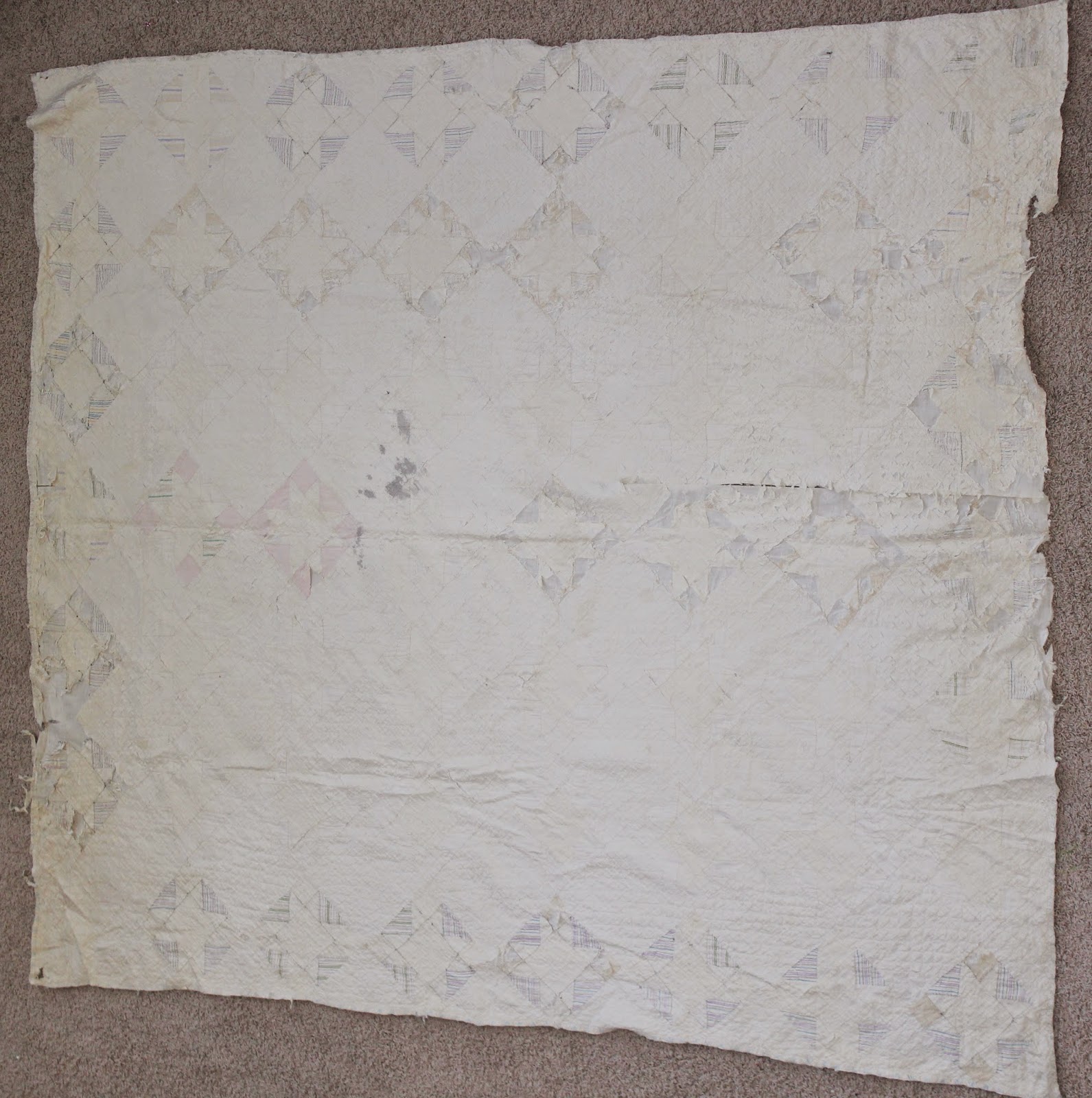
Sarah Dibble (Perkins) Tanner made these quilts.  I question one, just because the fabric feels like a 1970's suit and I am not familiar enough with fabric history to know if it could have come from her era.  I have tried to put the names of the fabric blocks or quilting patterns with the quilts and I will admit I am not an expert, so some could be incorrect.  I do know these quilts are handmade and beautiful and need to be shared.

This is a close up of the first one.  The colors are very light and fading so the pattern is harder to see with the whole quilt.
The first quilt. There is a rip down half of the middle of the quilt.
This one is one of my favorites.  The block pattern is most likely a feathered star pattern.
The hand quilting is also most likely a feathered star with a cable design on the bottom.

When I was researching this pattern I was completely intrigued. As far as I can tell it is called a Yankee Puzzle Quilt block pattern.  Considering she lived during the Civil War, was in the North and had two sons along with a son-in law fight for the North I have to wonder if it was made during that time period.
Here is a close up. And the next picture is the material used on the back.
It is such delicate cute patterns. I really like it.
This one is so simple, but like all of them so beautiful.  As a person who quilts and has hand quilting twin sized blankets, I completely understand the time put into making a quilt this size.
This one has the cross hatching quilting on it. I don't know if you can tell from the picture though the corners near the blue blocks are open corners, not solid squares like the rest.
More cable design for the borders.
As far as I have researched, this is a triple Irish Chain block pattern. 
I had to turn the quilt over to get a picture of the quilting pattern, which is a Baptist Fan quilting pattern. I did this one myself, by hand, on two quilts for my children.  
This last quilt is just a quilt top. It was never finished and it is the quilt I am not sure if it was made by her.  The material is so different and the stitching.  I have heard stitching is like handwriting, unique to each person.  

Sarah Dibble (Perkins) Tanner - Millard's Great Grandmother (Millard, William Roy, William Lewis, Sarah)

Sarah Dibble Perkins
1820-1884

     
Sarah Dibble (Perkins) Tanner

            Sarah Dibble Perkins was born November 13, 1820 in Meriden, New Haven, Connecticut to Amasa Perkins and Sally Dibble.  She was the first child out of 9 children.  According to stories told to her grandson, Van Buren Lamb, when she was a child, her parents moved to Ohio. At first she went with them, but then she became too frightened by the Indians and wolves that she was brought back to Connecticut to live with relatives.  Research note: I am still trying to figure out which family she went back to live with.  I am narrowing it down and will do a follow up post later.
            Before she was married she made many beautiful quilts for her trousseau along with aprons and other household items. 
This spinning wheel, along with another one, were brought to Ohio by wagon by Sarah's parents. It was later brought back and preserved by Sarah.  The other one has a large 6 foot spinning wheel and was also offered to my mom but she never had the means to bring it back from New York where Van lived before he died. 

This yarn winder was also Sarah's mother's and preserved by Sarah.  Either the spinning wheel or the yarn winder has the story etched on the bottom of it. 

One of the children's chores would be to collect the branches to make brushes for the house.  These are handmade brushes, a clothespin, a compass and some doilies.  I think the other item is a fire poker.  
An embroidered apron, handmade socks and doilies. 

Handmade baby bibs, socks and leather shoes. Written on the bottom of the shoes is "Joesph's first shoe 1863."  I haven't been able to find out who Joseph is. There are no grandchildren with that name.


All these items were left to my mom by Sarah's grandson, Van Buren, which he told us were from her household. The quilts I will post as a separate follow up story.
At the age of 17, on July 1, 1838, Sarah was baptized and admitted into the First Congregational Church in Wallingford, Connecticut and then on December 31, 1841 she was dismissed to the Congregational Church in Meriden, Connecticut, which means they would have given her a letter recommending her to the other church. A month later, on January 26, 1841, she married Lewis Alexander Tanner in Meriden, Connecticut.
Lewis Alexander Tanner
Their first child, Mary Alenah was born October 25, 1842. She followed by William Lewis on Mary 3, 1844.  On July 26, 1845 Norman Alexander was born.  All three were born in MeridenNew HavenConnecticut. (Pictures of her family can be found on Lewis' previous post).
            Sometime between 1845 and Jan 1849, Lewis and Sarah moved their family to New Haven, Connecticut.  Their address was 117 East Pearl Street, which was only a block away from the Quinnipiac River, just up from the New Haven Harbor. You can see a picture of their house on my post for Lewis. If you search for their house on googlemaps.com, the neighboring houses are still there and look similar to the picture of their home.  Where their house should be is a parking lot now.
On January 28, 1849, Sarah Anne was born in New Haven, passing away less than a month later on February 18, 1849.  Nancy Ally was born November 12, 1851 in New Haven.  Francis L was born next on May 8, 1854, living a few months and passing away on September 15, 1854.  In January 1856, when Nancy was about four years old, she also passed away. Lastly, Ida Lewie was born on November 18, 1860.  Lewis and Sarah had seven children, only four living to adulthood. All their children, except for Mary and William, were buried in the Fair Haven Union Cemetery
Sarah’s two sons joined the Civil War, William Lewis joined the Company B, 1st Regiment Connecticut Cavalry on July 1862 and Norman joined the Company H, 27 Regiment Connecticut Infantry on September 18, 1862 for nine months.  Norman was captured and sent to Libby Prison in Richmond, Virginia where he was imprisoned for 2 weeks.  Afterwards he was paroled and sent back to our lines. When he was honorable discharged from the infantry, he re-enlisted, this time to Company A, 1st Connecticut Heavy Artillery where he served until the close and was honorable discharged.
On December 24, 1863 her daughter Mary Alenah was married to John W Fielding. He was also a soldier in the Civil War.  He enlisted on August 11, 1862 into Company H, Connecticut 16th Infantry Regiment. After the war, Mary and John settled in Connecticut for awhile, moved to Massachusetts and ended up in Maine. They had 7 children also. 
           
Sarah Dibble (Perkins) Tanner
When her husband, Lewis, died in 1867, she was 47 years old. Her adult son Norman was living with her, her daughter Ida and Lewis’ business partner Seth DeWolf.  At this time, William Lewis returned home for about 18 months to help out and then returned to Minneapolis in 1869.  Norman was a book keeper and worked in real estate. He never married. Seth continued to live with them at least through 1880, as he is listed on the census as living there. In 1880 Sarah’s mother Sally is also living with them, though she is listed as a boarder. In 1880 Sarah has 4 other people also living there who are listed as boarders.
            
At the age of 64, Sarah passed away, on August 4, 1884.
Sarah Dibble (Perkins) Tanner
She was also buried in the Fair Haven Cemetery with her husband and children.  Ida and Norman continued living in their family home after her passing, even after Ida got married in 1897 to Van Buren Lamb Sr.  In November 1892, William filed a quit claim deed to Ida for their parent’s house for the amount of $1.00.  Norman continued to live with Ida and her family until his death in 1920.

The information on her parents is from her grandson, Van Buren Lamb Jr.’s notes and pictures in the family photo album. I am currently trying to find hard evidence of this to prove this line to the Daughters of the American Revolution. In Van Buren’s notes, he mentions a Dibble Family Bible. “ The Wittlesey Genealogy gives only one child Ruth born to this marriage, which I believe is due to the fact that she is the only child whose birth is recorded in Saybrook.  An old bible of Capt. Ely Morgan's, preserved by Jessie Morgan Jones of Lyme, Conn., gives nine children of this marriage.  Another proof of the nine children of Ruth and Josiah is the Bible of Amasa Perkins of Meriden, Conn. preserved by his descendant Ivan McComb of Alliance, Ohio.  This family near the Saybrook-Westbrook line for a short time lived in Wethersfield, Conn.” I have tried to get in contact with this line of the family but have had no success. 
Her baptism is recorded in Connecticut, Church Record Abstracts 1630-1920, vol. 118, pg 187 where her name is also recorded as “Sarah Dibble Perkins. Her and Lewis’ marriage information is recorded in the same place.
Norman’s military summary is found in the book William Tanner, Sr. of South Kingstown, Rhode Island and his descendants by Reb. George C. Tanner, D.D., Faribault, Minnesota. It is supported with military documents online and his compiled service record, which I have in my possession. 

Research Notes:

  1. As mentioned above, I am still looking for hard paper evidence proving Sarah to her parents for the DAR.
  2. I am interested in getting Norman’s Pension application and full service record for both companies he served in.  Will happen at a later date when I have some money to spare. I am trying to obtain his full service record but it might have to wait for a trip to Washington myself.
  3. I am also interested in ordering John W. Fielding’s Application for Pension but it will have to wait for the same reason of Norman’s. Same for his full service record.
  4. There should be a will of Sarah’s out there I am working on ordering.
  5. There is probably a will of Lewis’ that I need to see about ordering also. 

Tuesday, March 17, 2015

To wear green or orange on St. Patrick's Day?

This is just going to be a quick note today.  I have had these four leaf clover's with the Tanner possessions and I thought they belonged to them, until I talked to my mom today.  I turns out they were John McMillan Hayes' which would make more sense.  These are actual dried four leaf clovers that he owned and are now in my possession.  How cool is that?  Especially since today is St. Patrick's Day.

Also, to clear up any confusion.  The Hayes' family were Protestant Irish which orange is their symbol.  According to Wikipedia and yahoo.com the Protestant's wear orange and the Catholic's wear green. The flag of Ireland is a strip of orange to signify the Protestants and a strip of green to signify the Catholic's and a strip of white in the middle signifying the hope for peace between the two.

Personally, just because it's fun and seen more as a generic Irish color, I wear green on St. Patrick's day.

Monday, March 16, 2015

Kiss Me I'm Irish

Normally I will try to keep spouses next to each other, but in honor of St. Patrick's Day and I completely jumping lines to my maternal grandmother's line and honoring my ancestor John McMillan Hayes who comes from Belfast, Ireland. This is not the Tanner line at all and if you want to know how you're related to him, feel free to email me.  I have a wonderful story about him written by his daughter, Margaret Stoll Hayes.  She is his daughter from his second wife.

John M Hayes
(copy given to me by Ann Peterson)

JOHN MCMILLAN HAYES
(Written by his daughter Margaret Stoll Hayes)

            John McMillan (or McMullen) Hayes was born in Belfast, County Down, Ireland, September 18th, 1866, the son of John Orr and Ann McMullen Hays.
John Orr & Ann McMullen Hays
(picture from Ann Peterson)
His parents were honest, industrious, God fearing members of the Presbyterian Church. John was one of a family of ten children. Only the names of eight are available as yet. They are, Robert Brownlee, who was given a gold medal for being judged the best elocutionist in all England, Ireland and Scotland, and who played on the stage of London with such renowned actors as Barry Sullivan; William Hayes, Jean Brownlee Hayes, Margaret (Maggie) Hayes Hill, Samuel Hayes, Elizabeth Hayes and little Jenny who died before she was a year old. Despite the duties of caring for such a large family, no effort was spared by their kind mother in giving the training and love every child deserves.

            Honesty was one of the outstanding characteristics of the Hayes family. Once when John was only a small boy he found tuppence on the shelf of the cupboard. Several times he looked at it and felt it. Finally the temptation became so great that he took the money and went to the sweet shop and spent it. Candy was not common in his home and it was a treat that he soon finished. He returned home and soon his mother asked who had taken the money. No one answered, but no doubt John looked pretty guilty. At any rate, his mother picked him up and carried him outside. There was a pump outside with a bucket under it. Quickly she filled the bucket with water, and before he hardly realized what was happening, she held him, head down, over the water. He was sure she was going to drown him and in fright he confessed what he had done. She set him down on his feet and said, "I would rather have my child dead than that he be a liar." John never forgot the lesson. This is one of the few incidents he remembered about his Mother who died when he was only nine years old.
           
John M Hayes

            When a young man he joined a very unpopular religion, the Mormons. His father and step-mother, who were staunch and devout Presbyterians, were horrified when they learned, and refused him admittance to their home. They told him he was no longer their son, and that any clothes or money he might have in the house no longer belonged to him. This was indeed a sad situation as he had planned to emigrate to America and had saved a large portion of his fare. His reputation for honesty stood him in good stead now for he soon found a friend ready and willing to lend him the needed money. He sailed for the United States on the S.S. Nevada, of the Guion Line on Saturday, April 17th, 1886 and arrived in Salt Lake City on May 3rd. He met Eliza Stoll, who later became his wife, on the boat.

            In Ireland he learned the printing trade so when he arrived in Salt Lake he went to work as a printer's devil. (A printer's devil was an apprentice in a printing establishment who performed a number of task.) But he was determined to make something more of his life. He soon paid back his emigration loan and then spent all spare money and time studying book keeping. He was able later to pass the test as a CPA.
 
John M Hayes
Mission to Great Britain
(picture from Ann Peterson)
           
John M Hayes with missionary companions.
He is the top right
(Picture from Ann Peterson)
John M Hayes
Mission to Great Britain
(Picture from Ann Peterson)

John M Hayes
Missionary to Great Britain
(Picture from Ann Peterson)
Not many years later the Church called him on a mission to his native land and he was able to visit his people and was reconciled with his family. However, before they would see him he had to promise that he would never speak to them of his new religion.

            He came to Utah at the time polygamy was being practiced, and being a dedicated and devoted member of the Church he felt he should embrace the principle. He was married to Mary Ellen Fenton in August 1887 and to Eliza Stoll on November 9th of the same year.
Mary Ellen (Fenton) Hayes
John M Hayes
(Picture from Ann Peterson)
Eliza (Stoll) Hayes
(Picture from Ann Peterson)
It was a wonderfully happy situation, for the women were kind and unselfish and loved each other as sisters. It was a sad day for all when the manifesto was announced, for John could not accept it as the word of the Lord, and turned his back on the leaders of the Church. This made Eliza feel that there was not place now for her, and with love still burning in each heart they parted on the 25th of February, 1901.

            He was married four times. Mary Ellen Fenton, his first wife, was the mother of four sons and two daughters. Clara Jeanie; Robert Fenton, who was killed in a explosion at the copper mine in Bingham after saving the lives of many others; John Francis, who died in 1970; Edward Fenton; William Brownlee; and Marian. Eliza Stoll was the mother of twins; John Stoll who was still born and Margaret. Agnes Austin, his third wife was the mother of one son, John M Jr. who died at birth in March 1913 the day after Robert was killed. They were divorced in California. The fourth was the most unfortunate marriage. Margaret was a hypochondriac and that marriage ended very soon in divorce. The last eighteen years of his life he lived alone in hotel apartments in Los Angeles, being unwilling to live with any of his family lest he become a burden to them. During a part of this time, Mrs. Jessie West, a friend, cooked his meals, drove him in his car wherever he wished to go, and was a pleasant companion.

John McMillan with his children; Jeannie, Robert & Francis (Frank) Hayes
(picture from Ann Peterson)

            The following is copied from a letter written to John's daughter Margaret, at the time of his death, by Charles T. S. Parsons who was his dear friend and assistant at the Copper Company. "In 1903 the Utah Copper Company was organized... D.C. Jackling, one of the primer movers of the venture, who was making an inspection trip at the time, inquired of Lawrence Greene, a prominent Salt Lake business man, if he knew of an accountant he might get to make an analysis of the construction accounts. Mr. Greene had hear of Mr. Hayes' ability and recommended him for the assignment. Mr. Hayes performed the task so satisfactorily that Mr. Jackling remarked to Mr. Green: "Hayes is my man."
John McMillan Hayes

            "General offices of the Copper Company up to this time had been maintained in Colorado Springs. It was decided to expand the offices in Salt Lake City and Mr. Hayes was placed in charge. He put his analytical mind to work on the problems and in a short time the office was functioning smoothly and efficiently.

            During this period of early development many other problems presented themselves for solution and Mr. Jackling made good use of Mr. Hayes' ever expanding capacity. There was a matter of obtaining additional land facilities in which Mr. Hayes' sound judgment and careful bargaining abilities were manifest. In the matter of obtaining an adequate water supply for increased milling operations his contribution was outstanding. Then there was the problem of legislative enactments affecting the growing mining industry. Mr. Hayes' keen judgment and understanding did much to promote a reasonable tax climate for the industry. There was also the necessity for sound public relations, and Mr. Hayes proved himself exceptionally capable in this assignment. His abundance of friendliness, his rare wit and humor, his sense of fairness and good judgment did much to lay the foundation of the good will in which the present officers and employees take great pride. All of his various assignments were faithfully and effectively fulfilled and bear the hallmark of a many of many talents.

            "Mr. Hayes resigned his position as Assistant Secretary and Treasurer of the Company on December 31st, 1920, and moved with his family to Los Angeles, California."


            He died March 31, 1950 in a rest home in Los Angeles at the age of 83. He wished his body to be cremated and so stated in his will. His ashes were buried in the family plot beside his wife Mary, in the Salt Lake City Cemetery April 12th, 1950. At the time of his death he was survived by three sons and three daughters, ten grandchildren, seven great grandchildren and one great great grandchild. Will and Francis were at his bedside when he passed away. All of his living children attended his funeral which was held at the Erickson Funeral Home in Los Angeles. Short graveside services were held in Salt Lake.

            On one of Norman's and my many visits with Papa in Los Angeles, all three of my brothers with their wives came in to spend the evening. We had a delightful time together, but someone mentioned the presiding authority of the Mormon Church. It so happened that he was a person Papa did not like and he spoke out quite strongly against him. At that time I was a member of the Primary General Board and I said: "Please Papa, don't say those things about the President of my church. You know that I would not be where I am, not what I am, if it had not been for the training and opportunities I have had in the Church." He immediately reached over to where I was sitting, patted my hand and said: "I am sorry. I know what the Church has done. I am proud of you. Stay with the Church always and do what they ask of you."
 
Riverside Bowling Green May 19, 1928
(picture provided by Ann Peterson)
           At another time Norman and I went to pick him up at the bowling green at Exposition Park. While there he introduced us to a friend with whom he had been playing, as his son in law and daughter from Salt Lake. The man said, "Oh, that's where the --- Mormons live. I was glad to get through that town between two days." Papa preached him a regular sermon about the wonderful things the Mormon Church had done and about the outstanding and growing membership it had. Papa was so wrought up and disturbed that he talked about it all the way home from the park.
Riverside Bowling Green May 19, 1928
Margaret (Reed) Hayes (4th wife), John M Hayes and Eliza (Stoll) Hayes (2nd wife)
(Picture provided by Ann Peterson)
             At one time he said to me: "It's hard to admit you were wrong and to say you are sorry." And so I feel that he must have carried a testimony of the truthfulness of the Gospel in his heart always.
 
John M Hayes with his daughters, Jeannie, Margaret & Marian
(picture provided by Ann Peterson)
            He was a most wonderful, kind and loving Father to all of us.

This story was provided to me by Ann Peterson.  I added the pictures which most of them were also given to me by her.


Thursday, March 12, 2015

Lewis Alexander Tanner - father of William Lewis Tanner

Lewis Alexander Tanner
Lewis Alexander Tanner was born February 12, 1818 in either Lenox, Massachusetts, Pennsyvlania, or Connecticut.  In the book “William Tanner, Senior and his descendants, 1910” by Reverend George C. Tanner his birth is listed in Massachusetts. On the 1850 census, it states Connecticut. On a U.S. Civil War draft registration record, 1863-1865 his place of birth is listed as Pennsylvania. I am still researching this. He was the son of William Tanner and Anna Williams.  Lewis had four brothers and three sisters. 
            On January 26, 1841 he married Sarah Dibble Perkins in Meriden, Connecticut.

Sarah Dibble (Perkins) Tanner
 Their first child, Mary Alenah was born October 25, 1842 followed by William Lewis on Mary 3, 1844.  On July 26, 1845 Norman Alexander was born.  All three were born in Meriden, New Haven, Connecticut
Mary Alenah Tanner
William Lewis Tanner
Norman Alexander Tanner

Sometime between 1845 and Jan 1849, Lewis and Sarah moved their family to New Haven, Connecticut.  Their address was 117 East Pearl Street, which is only a block away from the Quinnipiac River, just up from the New Haven Harbor
117 East Pearl Street, New Haven, Connecticut
Map showing how close they were to the harbor. 
During this time, Lewis was a tinsmith and had a partner named Seth De Wolf who lived with them. They started to make oyster cans, a lucrative business at the time. Reverend George C. Tanner wrote that Lewis was one of the first to manufacture tin oyster cans. The cans were made by hand, cutting tin sheets that were bent around a cylindrical mold and the seam soldered.  Tops and bottoms were cut and soldered to the body. A cap hole was left in the top through which oysters were inserted. It was closed by soldering a cap over the hole.  The same type of can was used by vegetable and fruit canners in the summer and fall. Information about the tin cans were found just by a google search.  Lewis and Seth had their tin shop on the side of the house. They also made jacks for the kids and tin boxes. 

Homemade jacks and a wooden  ball made by Lewis A. Tanner
Tin boxes made by Lewis A. Tanner
On January 28, 1849, Sarah Anne was born in New Haven, passing away less than a month later on February 18, 1849.  Nancy Ally was born November 12, 1851 in New Haven.  Francis L was born next on May 8, 1854, living a few months and passing away on September 15, 1854.  In January 1856, when Nancy was about four years old, she also passed away.
 Lastly, Ida Lewie was born on November 18, 1860.
Ida Lewie Tanner
Lewis Alexander Tanner (Tintype)

(Their address at 117 E. Pearl Street is from both Van Buren Lamb and the picture of their house and also from U.S. City Directories, New Haven, Connecticut, City Directory, 1879 page 239. Accessed through Ancestry.com.)
(Lewis’ occupation is also noted in the above mentioned William Tanner book and is stated on the 1860 Federal Census).
(Lewis’ brother’s occupation noted in the book William Tanner, Sr. of South Kingston, Rhode Island and his descendants in four parts.  By Rev. George C. Tanner, D.D. Faribault, Minnesota)
(Lewis & Sarah’s marriage is recorded in the Connecticut, Church Record Abstracts, 1630 – 1920)(All their children are listed on censuses, gravestones and the above mentioned book)